FurrJam:Hop In!
- 4.9
- Rating
- 1.00M
- Installs
- Free
- Price

 Analysis by App-foxy
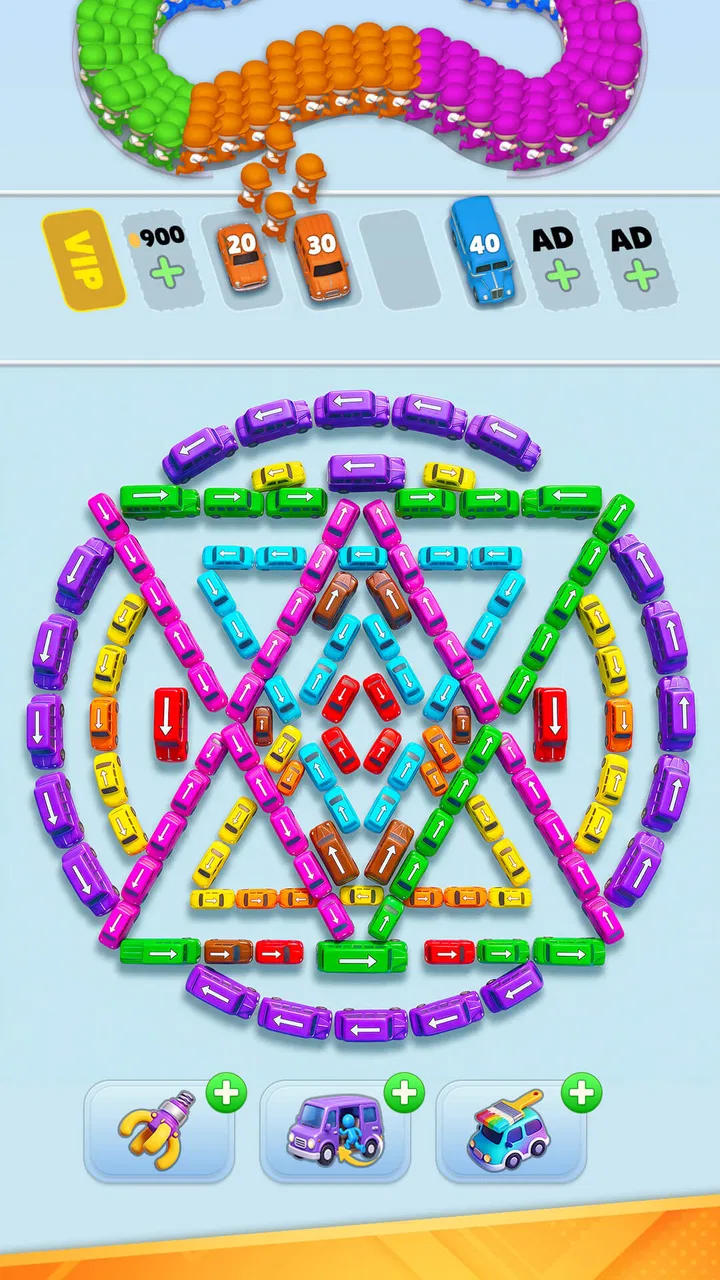
I spent time with FurrJam:Hop In! as a light traffic-jam puzzle, and its appeal became clearest when I treated it as a shared household game rather than a long-session challenge. The basic idea is easy to understand: vehicles and paths become tangled, and I have to work out how to release them in the right order. It is the kind of game I can open for a few minutes while waiting for dinner, then hand to someone else without needing to explain a complicated story or build system.
That simplicity is also the reason it works well on a shared phone or tablet. One person can make a move, another can point out a blocked route, and a child can try a different solution without anyone needing a separate account or a long tutorial. I would not describe it as a deep strategy game, but I found enough small decisions in each traffic arrangement to make the casual format satisfying. The best moments come when a puzzle looks completely jammed, then one careful move creates a chain reaction of open spaces.
The game is free to start and is listed for Everyone, which makes it approachable for a broad household audience. EASY PLAY GAME TECHNOLOGY LIMITED is the developer, and the game has attracted a 4.9 average from around 41 thousand ratings, alongside more than a million installs. Those figures suggest strong interest, but my recommendation is based more on how comfortably the game fits short, informal play than on its popularity.
You May Also Like

 Blood Strike: 2.5 Anniversary
Blood Strike’s Loadouts Turn Every Drop Into a Tactical Gamble
A close look at Blood Strike’s custom loadouts: how fast access to signature weapons reshapes its battle royale rhythm, rewards preparation, and narrows the gap between fights.

 Pandora - Music & Podcasts
Pandora’s Music Is Easy to Start, but Harder to Recover
Pandora’s strength is its low-effort path from a seed to a station. Its weak spot is how much confidence it asks you to place in connection, setup, and quiet recovery.

 8 Ball Pool
 Is Built on Rivalries, Rematches, and Routine
A close look at the rivalries, rematches, shared routines, and unanswered safety questions that turn a quick pool match into a persistent mobile community.

 Samsung Music
’s Quiet Strength Is Playing What You Already Own
Its reach comes less from spectacle than from dependable access to a personal library. That simplicity is both the app’s strongest retention engine and its ceiling.

 AccuWeather: Weather Radar
AccuWeather Review: A Quick, Clear Forecast for Everyday Decisions
For everyday plans, the best forecast is the one you can understand quickly. AccuWeather makes rain timing, radar, and local conditions easy to act on, with a few trade-offs.

 Hill Climb Racing
Why Hill Climb Racing Still Turns Crashes Into One More Run
A tiny car, a bumpy hill and one more upgrade: Hill Climb Racing keeps resurfacing because its simple chaos makes every near-miss feel personal.
More From Our News Desk



How FurrJam fits into shared-device play
I find shared-device play works best when the phone or tablet becomes a place to think together, not a contest over who gets to tap first. A simple turn-taking rule can keep each person involved while leaving room for different approaches to the same traffic puzzle. That also makes it easier to notice whether this kind of cooperative play suits your household before deciding how often to keep the game in rotation.
A good pass-and-play rhythm
On a shared device, the most useful quality here is that a puzzle can be understood visually. I do not need to remember a complicated objective between turns. Someone can look at the screen and immediately begin discussing which vehicle should move first, which lane is acting as a bottleneck, and whether clearing one side will help or hurt the remaining traffic.
That makes it suitable for small moments of cooperation. I can imagine one person holding the device while another acts as the “spotter,” looking ahead for a route that is easy to miss. This is more enjoyable than simply taking turns in silence because the puzzle naturally invites prediction. The person who is not touching the screen still has something useful to do: observe, suggest, and challenge the current plan.
There is a practical boundary, though. A shared-device session works best when players agree that the person holding the device makes the final move. Without that simple rule, two people can reach for the same control or argue over a solution before either has tested it. I found that the game encourages quick advice, but quick advice is not always good advice. The strongest household routine is to pause before each important move and say what result you expect.
Why short sessions feel natural
FurrJam is better suited to brief bursts than to a planned evening of gaming. Its casual design makes it easy to play while commuting, waiting for an appointment, or taking a break from chores. In a household, that means it can live on a common tablet without demanding a dedicated schedule. A parent can solve a puzzle before starting a task, while another family member can continue later when the device is free.
I especially liked the low commitment of the format. If I make a poor move, I can treat the attempt as a quick experiment rather than a major failure. That matters for younger players and for adults who do not normally choose puzzle games. The traffic-jam theme gives the action an immediate purpose, so the game does not need a lengthy explanation before it becomes understandable.
The trade-off is that this same accessibility may feel thin to players who want a persistent personal journey, character development, or a large collection of strategic tools. Compared with a more elaborate puzzle title, this is much closer to a quick mental diversion. I would choose it for convenience and shared play, not for a rich campaign or a complex competitive system.
Setting expectations before handing over the device
Because the game is easy to pick up, it can be tempting to hand over the device without any agreement. In my experience, a tiny bit of coordination improves the session. I would decide whether players are solving together or taking separate turns, and I would avoid interrupting a move that someone has already planned. This is particularly helpful when several people are watching a difficult traffic layout.
I would also make clear that the game is not a test of who is smartest. A puzzle can reward patience more than speed, and a younger player may notice a route that an adult overlooks. If the household treats every board as a shared problem, the game becomes a pleasant conversation starter. If every move is judged immediately, it can become frustrating, especially for someone still learning to read the visual arrangement.
One useful habit is to ask the player to explain the next two moves before acting. This slows down impulsive tapping and turns the puzzle into a small planning exercise. It also helps reveal whether the player understands the blocked paths or is simply trying random moves. I found this approach more valuable than giving away the answer, because the player still owns the solution.
What setup means on a common phone or tablet
The game runs on Android devices using version 6.0 or later, so it is compatible with a wide range of older hardware. That is helpful for a household where the newest phone belongs to one person and the shared tablet is several years old. Still, compatibility alone does not guarantee the same comfort everywhere. A smaller screen may make a crowded traffic arrangement harder to read, while a larger tablet can make group observation easier.
Before installing it on a shared device, I would check who normally uses that device and whether the household is comfortable with game-related purchases appearing there. The game itself is free, but optional in-app purchases range from $1.99 to $99.99 per item. That is not a reason to avoid it automatically, yet it is a strong reason to establish purchase boundaries before a child or guest starts playing.
I would not rely on a child’s understanding of the word “free.” In everyday use, “free to download” and “free of charge in every situation” are different ideas. A short household rule—no purchase without asking the device owner—prevents confusion. If the device is used by several people, the owner should also make sure that the store account and payment process are handled by the adult responsible for the device.
There is another boundary worth considering: personal progress. On a shared device, players may not have a clear separation between one person’s activity and another’s. I would avoid assuming that every household member has an individual space unless the game visibly provides one during use. For casual pass-and-play, this is not a serious problem. For someone who wants carefully separated progress, it is better to confirm the available account behavior directly on the device before making the game a personal long-term project.
Coordinating solutions instead of competing for control
The traffic-jam format gives families a natural way to coordinate. One player can scan the whole board, another can focus on the exit route, and a third can remember which move caused trouble in the previous attempt. I found that dividing attention this way is more effective than having everyone shout general instructions such as “move that one.” Specific language helps: identify the vehicle, name the direction, and explain what space the move should create.
This is also where the game can teach a useful everyday habit: do not solve only the immediate blockage. A move that opens one vehicle may close the route needed by another. I started looking for the board’s most constrained area first, then worked backward to determine which pieces had to move before it could be cleared. That approach is more reliable than moving the easiest vehicle simply because it is available.
For a child playing with an adult, I would let the child choose the first plan and ask questions rather than taking over. “What will be behind that vehicle after it moves?” is more helpful than “No, do this instead.” The game is simple enough for a child to participate meaningfully, but the adult may need to control the pace so that the session does not become a sequence of hurried guesses.
For siblings or friends, alternating the role of planner and mover works well. The planner describes the intended sequence, while the mover performs it. Then they switch. This gives the quieter player a clear role and prevents the person with the fastest reactions from controlling every turn. It also exposes an important trade-off: a plan that sounds obvious may be difficult to communicate precisely, so players learn to be clearer with each other.
Age context and trust
The Everyone rating makes FurrJam an easy candidate for mixed-age casual play, especially because the central challenge is visual problem solving rather than a mature theme. Even so, an age label does not replace supervision or household judgment. Younger players may understand the puzzle quickly but still need help with device handling, purchase boundaries, and knowing when to stop after repeated failed attempts.
I would be comfortable introducing it as a cooperative puzzle activity, not as an unsupervised reward system. The difference matters. When an adult sits nearby, the game can become a chance to discuss planning, patience, and consequences. When it is handed over as a way to keep a child occupied indefinitely, its short, repetitive nature may not provide the variety the household expects.
Trust also applies to shared-device privacy and account habits. I would keep the device owner’s store account under adult control and avoid allowing a child to make decisions about optional purchases without permission. I would also explain that a free game can still present paid choices. That conversation is useful even if the player never buys anything, because it builds sensible habits around mobile games.
Adults should consider temperament as well as age. A player who enjoys retrying a blocked puzzle may find the game calming, while someone who becomes upset when a plan fails may need short sessions and frequent breaks. The casual category does not mean every moment will feel relaxed. Traffic puzzles can be surprisingly irritating when a player believes the solution is obvious but cannot execute it cleanly.
Where the game differs from usual casual alternatives
Compared with match-three games, FurrJam asks for more forward planning and less reliance on repeated pattern matching. I cannot simply wait for a lucky combination to appear; I need to understand how the available space changes after a move. That makes it a better choice when I want a small logic challenge rather than a purely reflexive distraction.
Compared with word puzzles, it is more immediately accessible to players who may not enjoy spelling or vocabulary tasks. The visual traffic layout communicates the problem quickly, so language ability is less central to the basic interaction. On the other hand, word games often offer a stronger sense of personal knowledge growth, while this game focuses on spatial sequencing.
Compared with large strategy games, FurrJam is much less demanding. There is no need to learn a broad rule set before playing, and a household can begin cooperating almost immediately. The downside is that players seeking deep systems, long-term planning, or a strong narrative will probably outgrow it. I would choose a more substantial puzzle or strategy game for a dedicated gaming session, especially if the group wants progression that feels personal and persistent.
Its strongest comparison point is convenience. Many casual games are easy to start, but not all are equally good for someone watching over the player’s shoulder. The traffic-jam layout is readable enough for conversation, which gives this game a social edge even though the core action is simple. That advantage matters most on a shared tablet, where spectators are part of the experience.
Small techniques that improve the experience
My first practical tip is to identify the exit or target route before touching anything. In a crowded layout, the most visually prominent vehicle is not necessarily the one that should move first. I look for the piece that is blocking the narrowest passage and then ask what must be cleared to free it. This reduces wasted moves and makes the puzzle feel more deliberate.
My second tip is to avoid making several “harmless” moves in a row. A vehicle that appears safe to shift may occupy a useful space later. I prefer making one move, checking the new arrangement, and then revising the plan. This is especially important when a child is playing, because it turns the game from frantic tapping into a visible cause-and-effect exercise.
My third tip is to use a spoken sequence during shared play. Saying “clear the side lane, open the center, then release the blocked vehicle” gives everyone a common plan without requiring one person to grab the device. If the move fails, the group can identify which assumption was wrong instead of blaming the player.
A fourth useful habit is to stop after a few failed attempts and reset mentally. Repeating the same sequence faster rarely helps. I found that looking at the board as if it were new often reveals that I had been treating one vehicle as important when the real bottleneck was elsewhere. This is a simple technique, but it prevents the game from turning a short break into an unnecessarily tense session.
Who should choose it, and who should pass
I would recommend FurrJam to someone who wants a free casual game for short sessions, especially if the game may be played around other people. It is a good fit for families who enjoy discussing solutions, for adults who want a quick spatial challenge, and for households with an older Android tablet that still meets the minimum system requirement.
I would be more cautious about recommending it to players who want a clearly separated personal profile on a shared device, a substantial story, or a deep progression system. I would also skip it for anyone who dislikes retrying logic puzzles or who expects every free game to avoid paid options entirely. The optional purchase range makes household rules important, particularly when children use the same store account.
Players looking for competitive multiplayer, rich customization, or a long-term strategic hobby should choose a different category. FurrJam is not trying to fill those roles. Its value is narrower and more practical: it turns a few spare minutes into a visual problem that can be solved alone or discussed with someone sitting nearby.
My household verdict
After using it as both a solo diversion and a shared-device puzzle, I see FurrJam as a friendly addition to a casual game collection. Its traffic layouts are easy to understand, but they still reward restraint, sequencing, and careful observation. The game works particularly well when players cooperate instead of competing for the screen, and it gives adults a simple way to guide younger players without solving everything for them.
The important conditions are straightforward: agree on turns, keep purchases under the device owner’s control, and do not assume that a shared device automatically provides separate personal progress. With those boundaries in place, the game can fit naturally into a household routine. It is suitable for a quick break, a waiting-room distraction, or a few minutes of family problem solving.
The current version is 15.0, and the game was released on February 12, 2026. I would judge it as a focused casual experience rather than a complete all-purpose game. Its real strength is the combination of instant visual readability and cooperative discussion. If that is what you want from a free puzzle, I think it is worth trying. If you need depth, competitive features, or a carefully separated account experience, I would look elsewhere.
FAQs for FurrJam:Hop In!
01What is FurrJam: Hop In! and what kind of game is it?
FurrJam: Hop In! is a casual mobile game centered around playful animal characters and quick, accessible gameplay. It is designed for short sessions, making it easy to play when you have a few spare minutes, while still offering goals to complete and challenges to overcome. The colorful presentation and simple controls make it suitable for a broad range of players, including those who prefer relaxed, family-friendly games.
02Is FurrJam: Hop In! free to download and play?
FurrJam: Hop In! can generally be downloaded without an upfront purchase, but players should check the store listing for the current pricing and monetization details in their region. Like many free mobile games, it may include optional in-app purchases, advertisements, or extra content. These purchases are not necessarily required to enjoy the core experience, although they may help unlock items or provide additional convenience during progression.
03Does FurrJam: Hop In! require an internet connection?
The internet requirements may depend on the specific feature you are using and the version installed on your device. Basic gameplay may be available offline in some situations, but online access can be needed for advertisements, updates, cloud-related features, events, or other connected services. If you plan to play while traveling or without mobile data, it is best to test the game once online and confirm which functions remain available offline.
04Is FurrJam: Hop In! suitable for children?
FurrJam: Hop In! uses a bright, cartoon-style presentation and straightforward gameplay that may appeal to children and families. However, parents should review the age rating, privacy information, advertising practices, and in-app purchase settings before allowing younger players to use it. Device-level purchase restrictions are recommended, particularly if the game offers optional paid items or displays advertisements that may not be appropriate for every age group.
05Which devices are compatible with FurrJam: Hop In!?
Compatibility depends on the operating system, device model, available storage, and the requirements specified by the official Android or iOS store listing. Before downloading, check that your phone or tablet uses a supported version of the operating system and has enough free space for installation and updates. Older devices may technically run the game but could experience slower loading, reduced performance, or occasional stability issues.
Pros
- Quick
- casual rounds are easy to pick up and play anytime.
- Cute furry characters give the game a charming visual identity.
- Simple controls make it accessible for younger and casual players.
- Short sessions work well for playing on the go.
- The lively presentation keeps the gameplay feeling upbeat.
Cons
- Progression may feel repetitive after extended play sessions.
- Some challenges can depend more on timing than strategic choices.
- The small player base may make online activity inconsistent.
- Visual effects can become distracting during busy moments.
- Players looking for deep customization may find options limited.

FurrJam:Hop In!
Gallery